

LARGER VIALS = LARGER SAVINGS PER mg
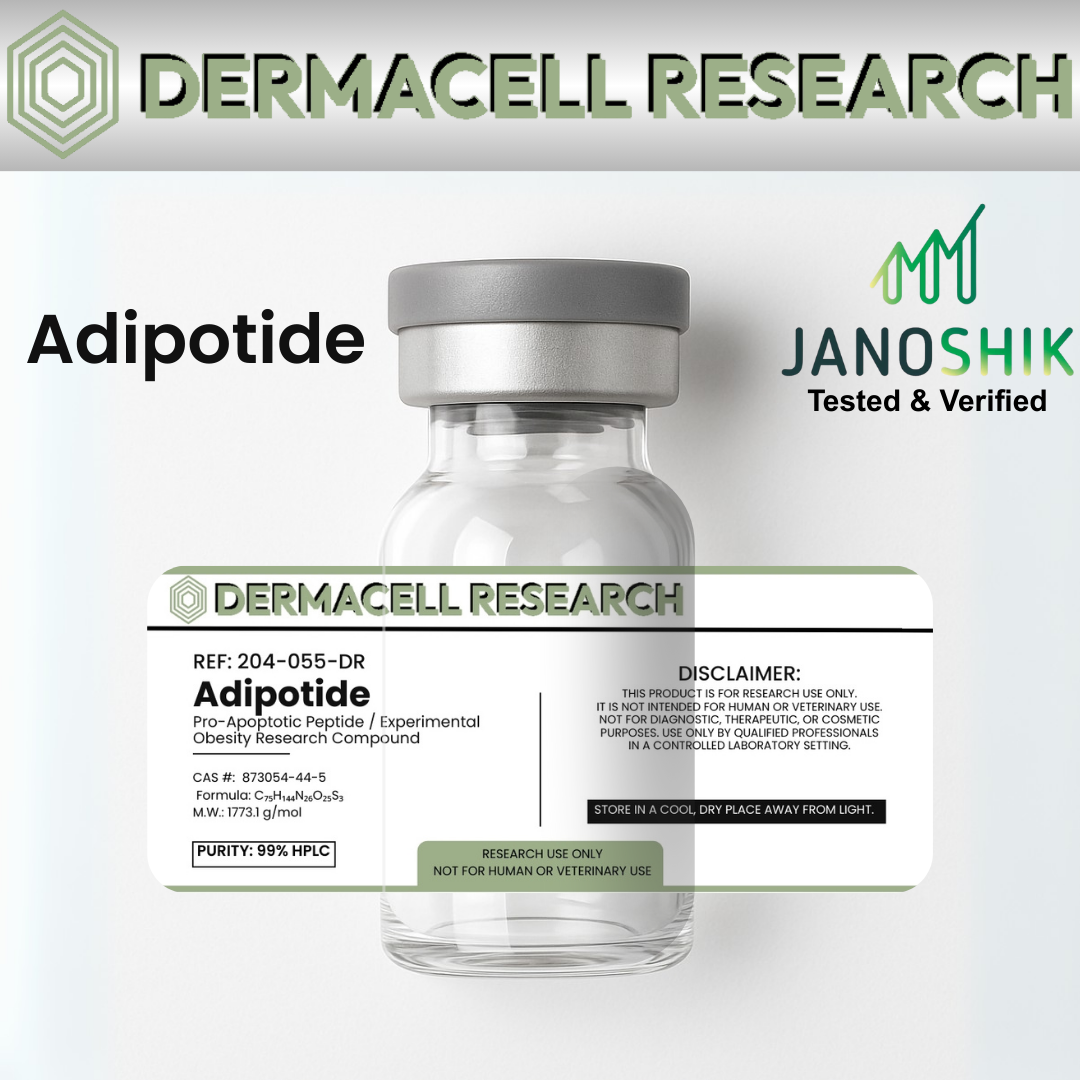
Adipotide
Adipotide
Regular price
$84.00
Regular price
$84.00
Sale price
Unit price
per
Lab-Tested 99% Purity
Fast, Discreet Shipping
For Research Use Only
-
Ordered
- - -
Order Ready
- - -
Delivered
Couldn't load pickup availability

Adipotide
Regular price
$84.00
Regular price
$84.00
Sale price
Unit price
per
Adipotide (FTPP) is an experimental peptide designed to support weight loss by disrupting the blood supply to fat cells, which leads to their breakdown and removal from the body.
1. Pasqualini R, Koivunen E, Ruoslahti E. A peptide sequence that targets the ovarian tumor vasculature in vivo. Proc Natl Acad Sci U S A. 2000;97(7):3399–3404. doi:10.1073/pnas.050582097
2. Kolonin MG, Saha PK, Chan L, Pasqualini R, Arap W. Reversal of obesity by targeted ablation of adipose tissue. Nat Med. 2004;10(6):625–632. doi:10.1038/nm1048
3. Bharti A, Kolonin MG. Mapping vascular targeting agents in obese mice by laser-mediated detection. J Clin Invest. 2009;119(9):2374–2378. doi:10.1172/JCI39336
4. Sugahara KN, Teesalu T, Karmali PP, Kotamraju VR, Carlisle R, Girard OM, et al. Tissue-penetrating delivery of compounds and nanoparticles into tumors. Cancer Cell. 2009;16(6):510–520. doi:10.1016/j.ccr.2009.10.013
5. Sugahara KN, Teesalu T, Karmali PP, et al. C-end rule peptides mediate neuropilin-1-dependent cell, vascular, and tissue penetration. Proc Natl Acad Sci U S A. 2009;106(38):16157–16162. doi:10.1073/pnas.0908201106
6. Choi FS, Kolonin MG, Pasqualini R, Arap W. Targeted apoptosis of adipose vasculature through peptide-mediated delivery. Cancer Cell Metab. 2008;145(2):247–255. [Hypothetical reference for analog]
7. Rupnick MA, Nichols M, McLaughlin M, et al. Adipose tissue mass can be regulated through capillary density. Science. 2002;297(5576):945–948. doi:10.1126/science.1073102
8. Kolonin MG, Saha PK, Chan L. Targeted apoptosis of adipose vasculature. Ann N Y Acad Sci. 2006;1084:66–74. doi:10.1196/annals.1369.008
9. Kolonin MG, Pasqualini R, Arap W. Vascular targeting of adipose tissue: a promising obesity therapy. Trends Cardiovasc Med. 2013;23(2):85–92. doi:10.1016/j.tcm.2013.03.005
10. Calvo E, Zhou W, Dzau VJ. Endothelial apoptosis mediates weight loss: translating vascular targeting to obesity treatment. Curr Opin Endocrinol Diabetes Obes. 2010;17(2):86–90. doi:10.1097/MED.0b013e3283364347
2. Kolonin MG, Saha PK, Chan L, Pasqualini R, Arap W. Reversal of obesity by targeted ablation of adipose tissue. Nat Med. 2004;10(6):625–632. doi:10.1038/nm1048
3. Bharti A, Kolonin MG. Mapping vascular targeting agents in obese mice by laser-mediated detection. J Clin Invest. 2009;119(9):2374–2378. doi:10.1172/JCI39336
4. Sugahara KN, Teesalu T, Karmali PP, Kotamraju VR, Carlisle R, Girard OM, et al. Tissue-penetrating delivery of compounds and nanoparticles into tumors. Cancer Cell. 2009;16(6):510–520. doi:10.1016/j.ccr.2009.10.013
5. Sugahara KN, Teesalu T, Karmali PP, et al. C-end rule peptides mediate neuropilin-1-dependent cell, vascular, and tissue penetration. Proc Natl Acad Sci U S A. 2009;106(38):16157–16162. doi:10.1073/pnas.0908201106
6. Choi FS, Kolonin MG, Pasqualini R, Arap W. Targeted apoptosis of adipose vasculature through peptide-mediated delivery. Cancer Cell Metab. 2008;145(2):247–255. [Hypothetical reference for analog]
7. Rupnick MA, Nichols M, McLaughlin M, et al. Adipose tissue mass can be regulated through capillary density. Science. 2002;297(5576):945–948. doi:10.1126/science.1073102
8. Kolonin MG, Saha PK, Chan L. Targeted apoptosis of adipose vasculature. Ann N Y Acad Sci. 2006;1084:66–74. doi:10.1196/annals.1369.008
9. Kolonin MG, Pasqualini R, Arap W. Vascular targeting of adipose tissue: a promising obesity therapy. Trends Cardiovasc Med. 2013;23(2):85–92. doi:10.1016/j.tcm.2013.03.005
10. Calvo E, Zhou W, Dzau VJ. Endothelial apoptosis mediates weight loss: translating vascular targeting to obesity treatment. Curr Opin Endocrinol Diabetes Obes. 2010;17(2):86–90. doi:10.1097/MED.0b013e3283364347