

LARGER VIALS = LARGER SAVINGS PER mg
AOD-9604
AOD-9604
Lab-Tested 99% Purity
Fast, Discreet Shipping
For Research Use Only
-
Ordered
- - -
Order Ready
- - -
Delivered
Couldn't load pickup availability

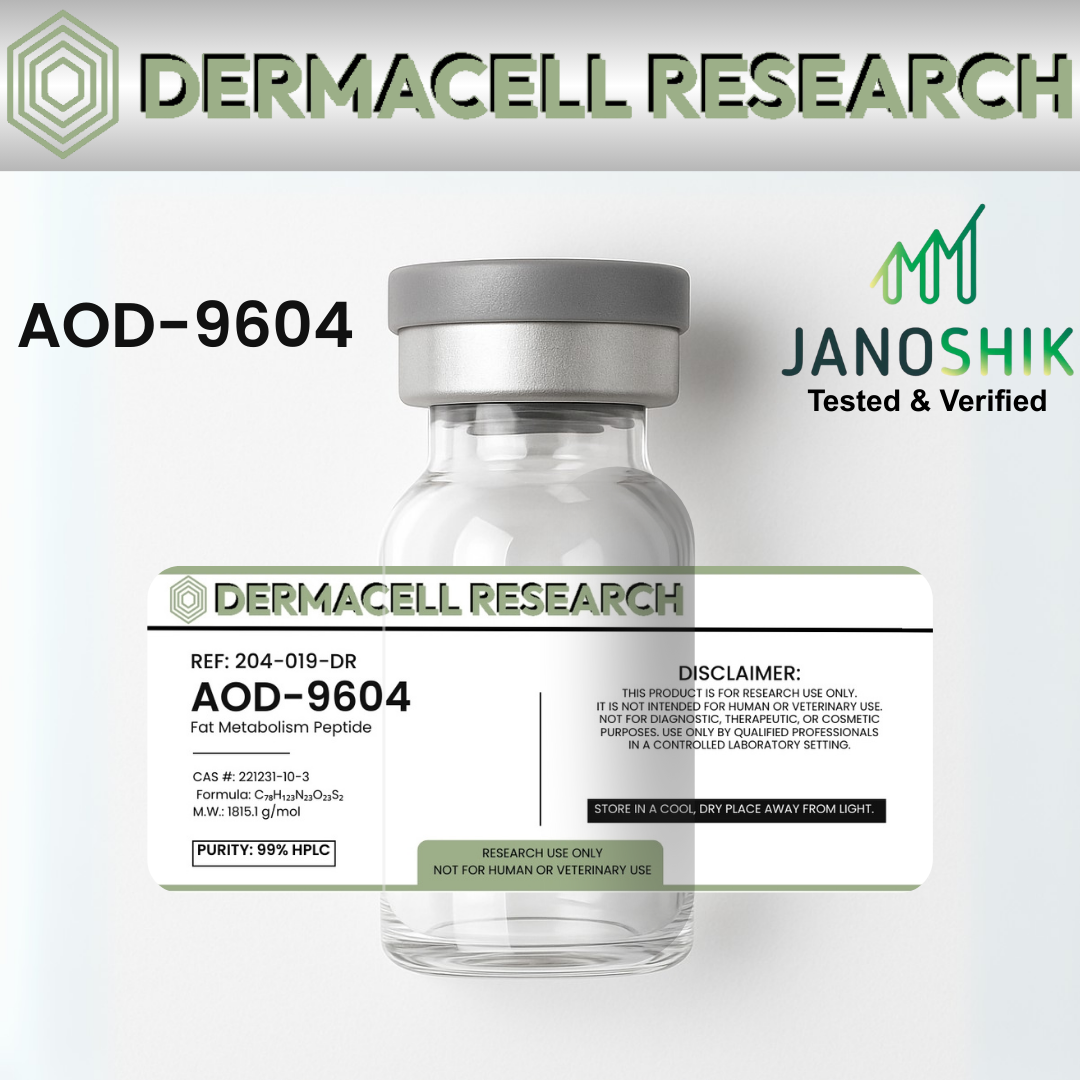
AOD-9604
AOD-9604 is a synthetic peptide fragment derived from the C-terminal region of human growth hormone (HGH 176–191). It has been investigated for its potential to stimulate lipolysis and inhibit lipogenesis without affecting insulin sensitivity or blood glucose regulation, making it a candidate for metabolic and obesity research.
2. Ng FM, et al. The lipolytic and anti-lipogenic actions of hGH fragment 177–191. Endocrinology. 2000;141(7):2686–2692. doi:10.1210/endo.141.7.7596
3. Heffernan MA, Ng FM, Sainsbury A. Clinical trials of AOD9604, a novel obesity treatment. Obes Res Clin Pract. 2005;3(4):215–222.
4. Ng FM. Studies on the metabolic effects of the C-terminal fragment of hGH. Horm Res. 1999;51(Suppl 2):72–79. doi:10.1159/000053176
5. Ng FM, Eisman JA. The C-terminal fragment of growth hormone: activity and therapeutic potential. Clin Exp Pharmacol Physiol. 1994;21(9):633–640. doi:10.1111/j.1440-1681.1994.tb02592.x
6. Sainsbury A, et al. Effects of AOD9604 on weight and fat metabolism in mice. Diabetes Obes Metab. 2003;5(6):411–417. doi:10.1046/j.1463-1326.2003.00302.x
7. Ng FM, et al. Growth hormone fragment 177–191 inhibits lipogenesis in obese mice. Metabolism. 1990;39(7):794–798. doi:10.1016/0026-0495(90)90028-H
8. Heffernan M, et al. AOD9604: a case study in fragment-based peptide therapy for obesity. Expert Opin Investig Drugs. 2010;19(2):275–283. doi:10.1517/13543780903568758
9. Healey J, Ng FM. Effects of growth hormone fragment 177–191 on fat oxidation in humans. J Clin Endocrinol Metab. 1997;82(6):1936–1940. doi:10.1210/jcem.82.6.3966
10. Ng FM. GH fragments and lipolysis: implications for therapeutic peptide design. Peptides. 2003;24(9):1451–1457. doi:10.1016/S0196-9781(03)00224-0