Skip to product information

LARGER VIALS = LARGER SAVINGS PER mg

Cerebrolysin

Cerebrolysin

Regular price $110.00
Regular price $110.00 Sale price
SAVE Liquid error (snippets/price line 116): Computation results in '-Infinity'% Sold out
 

science Lab-Tested 99% Purity

local_shipping Fast, Discreet Shipping

school For Research Use Only

 
add_shopping_cart

-

Ordered

local_shipping

- - -

Order Ready

redeem

- - -

Delivered

Cerebrolysin

Cerebrolysin

Regular price $110.00
Regular price $110.00 Sale price
SAVE Liquid error (snippets/price line 116): Computation results in '-Infinity'% Sold out

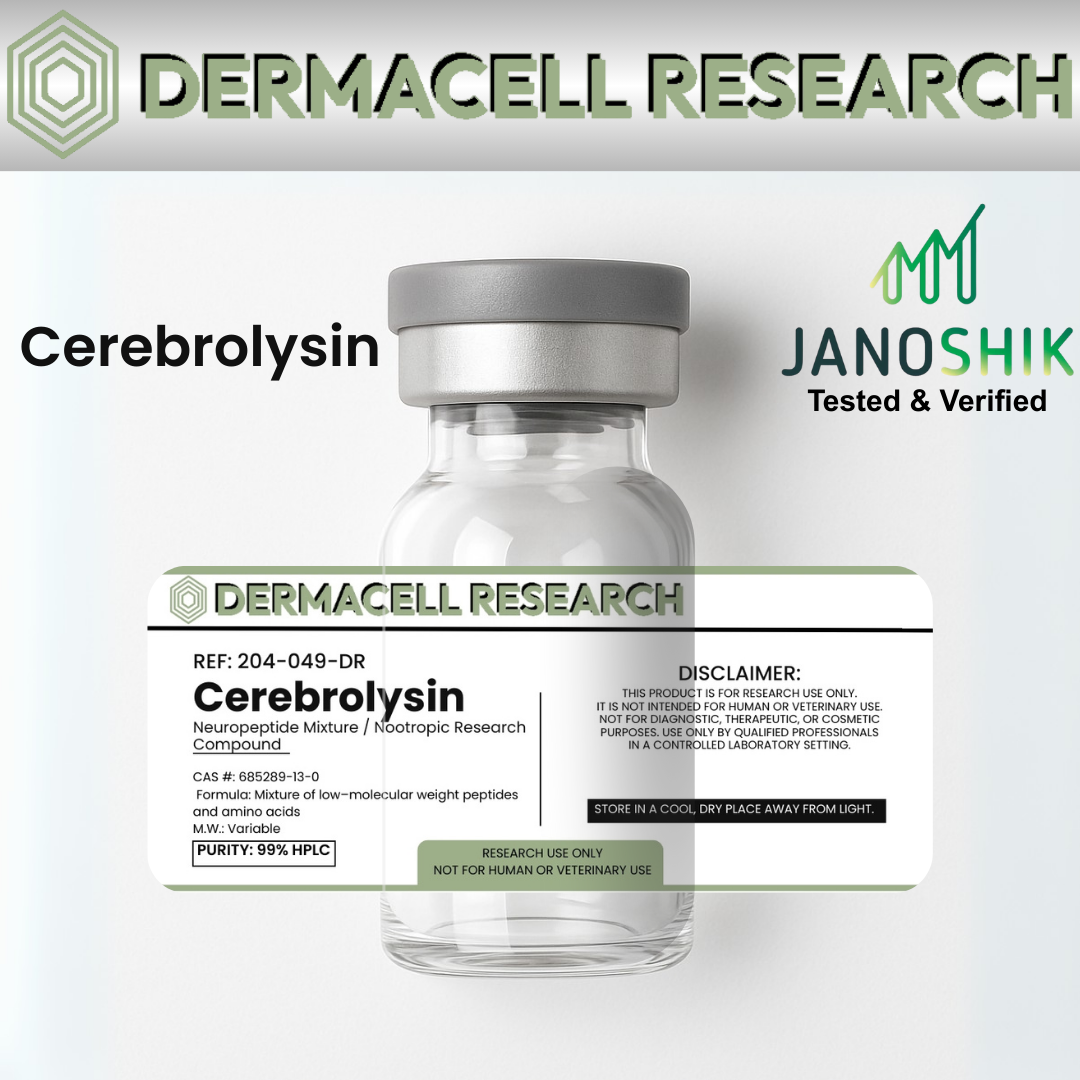
Cerebrolysin is a peptide-based neuroprotective agent derived from enzymatic breakdown of porcine brain proteins. It has been investigated for its potential to enhance neurotrophic activity, support synaptic plasticity, and improve cognitive function in conditions such as stroke and neurodegenerative diseases.
View full details
  • DESCRIPTION
  • STORAGE
  • REFERENCES

Cerebrolysin is a neuropeptide preparation obtained by enzymatic breakdown of purified porcine brain proteins. It contains a mixture of biologically active low–molecular weight peptides and free amino acids designed to cross the blood–brain barrier and exert neuroprotective and neurotrophic effects. It has been studied extensively in stroke, traumatic brain injury (TBI), vascular dementia, and Alzheimer’s disease.

Composition

  • Source: Porcine brain-derived peptides
  • Components: Neurotrophic peptides (<10 kDa), amino acids
  • Form: Sterile injectable solution
  • Mechanism: Neurotrophic and neuroprotective activity, mimicking endogenous neurotrophins

Research

Neuroprotection

Cerebrolysin reduces excitotoxicity, oxidative stress, and apoptosis in models of neuronal injury. It stabilizes neuronal membranes and improves mitochondrial function, protecting neurons during ischemia and trauma.

Neurotrophic Effects

The peptide mixture mimics natural growth factors (e.g., BDNF, NGF) by stimulating neurite outgrowth, synaptic plasticity, and neurogenesis. This supports functional recovery after brain injury and enhances cognitive performance.

Stroke

Multiple randomized controlled trials suggest that Cerebrolysin may improve neurological recovery in acute ischemic stroke, particularly when combined with standard care. It has been associated with better outcomes on NIH Stroke Scale (NIHSS) and modified Rankin Scale (mRS) scores.

Traumatic Brain Injury (TBI)

Studies report improved functional independence, motor recovery, and cognitive rehabilitation in TBI patients treated with Cerebrolysin compared to placebo.

Dementia & Alzheimer’s Disease

Cerebrolysin has been tested in patients with mild to moderate Alzheimer’s disease, showing improvements in cognitive function, memory, and activities of daily living, with a good safety profile.

Safety Profile

Cerebrolysin is generally well tolerated. Reported side effects include mild dizziness, headache, or transient agitation. No evidence of immunogenicity or long-term adverse events has been reported.

Summary

Cerebrolysin is a porcine brain–derived peptide preparation with neuroprotective and neurotrophic actions. Research highlights include:

  • Neuroprotection in ischemia and trauma
  • Improved functional recovery after stroke and TBI
  • Cognitive and daily living benefits in Alzheimer’s disease
  • Good overall safety profile in clinical trials

It is considered a promising therapeutic candidate for neurodegenerative diseases and brain injury rehabilitation.

Cerebrolysin is supplied as a sterile injectable solution. Store at 2–8 °C, protected from light. Do not freeze. Once a vial or ampoule is opened, use immediately under sterile conditions and discard any unused portion.

1. Alvarez XA, et al. Cerebrolysin in Alzheimer’s disease: a randomized, double-blind, placebo-controlled study. Drugs Aging. 2006;23(7):623–632. doi:10.2165/00002512-200623070-00005

2. Chen N, Yang M, Guo J, Zhou M, Zhu C, He L. Cerebrolysin for vascular dementia. Cochrane Database Syst Rev. 2013;(1):CD008900. doi:10.1002/14651858.CD008900.pub2

3. Ziganshina LE, Abakumova T, Vernay L. Cerebrolysin for acute ischemic stroke. Cochrane Database Syst Rev. 2020;(7):CD007026. doi:10.1002/14651858.CD007026.pub5

4. Heiss WD, Brainin M, Bornstein NM, et al. Cerebrolysin in patients with acute ischemic stroke: a randomized, placebo-controlled trial. Stroke. 2012;43(3):630–636. doi:10.1161/STROKEAHA.111.628537

5. Zhang C, et al. Cerebrolysin improves outcomes after traumatic brain injury in clinical trials. Neurorehabil Neural Repair. 2016;30(10):931–942. doi:10.1177/1545968316638673

6. Cramer SC, et al. Role of Cerebrolysin in stroke rehabilitation. Curr Med Res Opin. 2019;35(10):1711–1719. doi:10.1080/03007995.2019.1631809

7. Plosker GL. Cerebrolysin: a review of its use in dementia and stroke. CNS Drugs. 2010;24(8):707–727. doi:10.2165/11205090-000000000-00000

8. Ruíz-Sandoval JL, et al. Efficacy and safety of Cerebrolysin in moderate to severe TBI. Clin Drug Investig. 2007;27(9):583–591. doi:10.2165/00044011-200727090-00004

9. Masliah E, et al. Neurotrophic peptides and synaptic protection: mechanism of action of Cerebrolysin. J Neural Transm Suppl. 2002;(62):347–356. doi:10.1007/978-3-7091-6081-7_27

10. Bornstein NM, et al. Safety and efficacy of Cerebrolysin in ischemic stroke: pooled analysis of clinical trials. Neurol Sci. 2014;35(5):645–654. doi:10.1007/s10072-013-1607-8