Skip to product information

LARGER VIALS = LARGER SAVINGS PER mg

CJC-1295 (with DAC)

CJC-1295 (with DAC)

Regular price $88.00
Regular price $88.00 Sale price
SAVE Liquid error (snippets/price line 116): Computation results in '-Infinity'% Sold out
 

science Lab-Tested 99% Purity

local_shipping Fast, Discreet Shipping

school For Research Use Only

 
add_shopping_cart

-

Ordered

local_shipping

- - -

Order Ready

redeem

- - -

Delivered

CJC-1295 (with DAC)

CJC-1295 (with DAC)

Regular price $88.00
Regular price $88.00 Sale price
SAVE Liquid error (snippets/price line 116): Computation results in '-Infinity'% Sold out

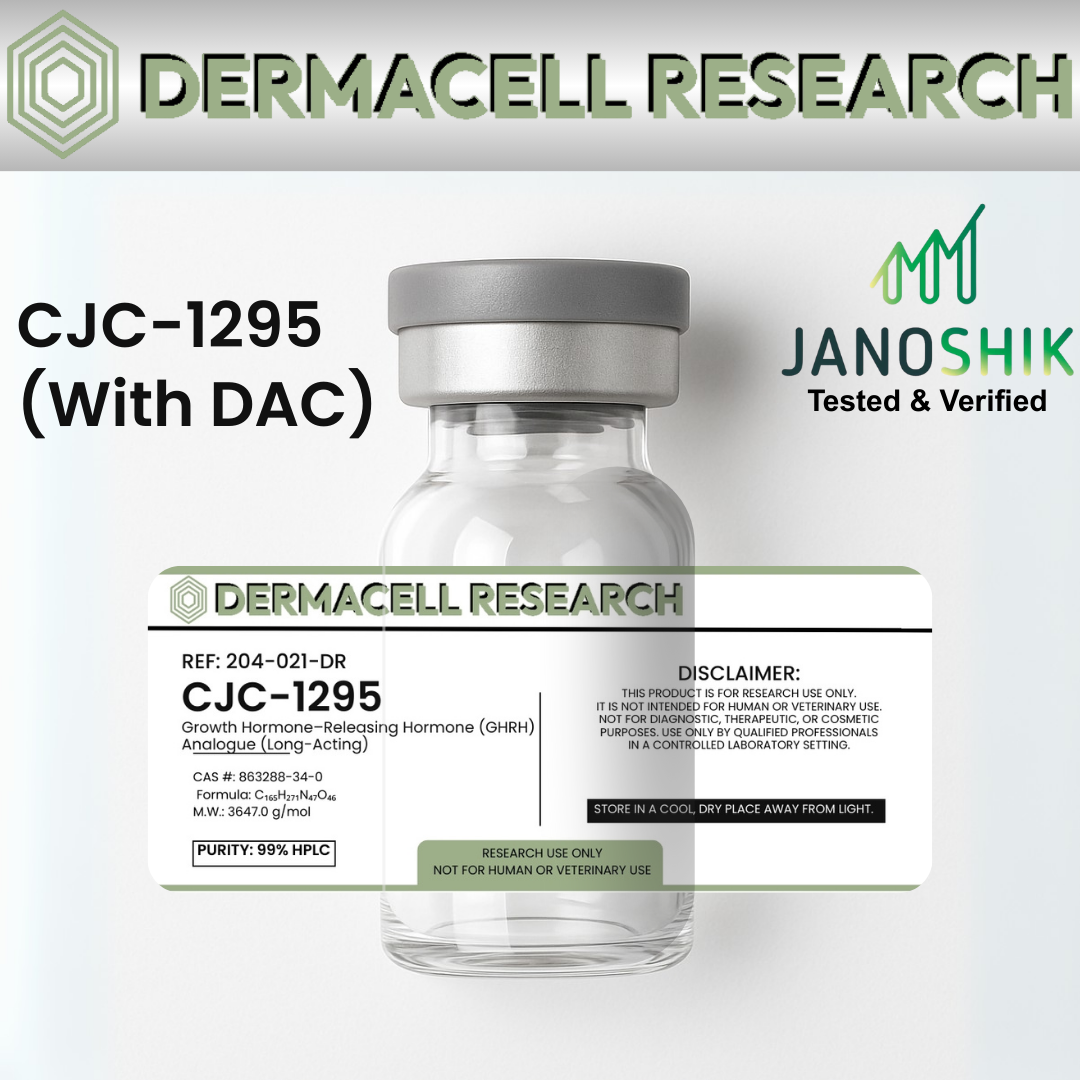
CJC-1295 with DAC (Drug Affinity Complex) is a synthetic analogue of growth hormone–releasing hormone (GHRH) modified to bind to serum albumin, significantly extending its half-life. This prolonged activity allows for sustained stimulation of growth hormone release and elevated IGF-1 levels, which have been studied for their roles in metabolism, tissue repair, and body composition.
View full details
  • DESCRIPTION
  • STORAGE
  • REFERENCES

CJC-1295 with DAC (Drug Affinity Complex) is a long-acting growth hormone–releasing hormone (GHRH) analogue designed to stimulate and sustain the release of growth hormone (GH). Compared to CJC-1295 No DAC, which has a short half-life (~30 minutes), the addition of the Drug Affinity Complex extends the peptide’s half-life to approximately 6–8 days, allowing for once- or twice-weekly administration. This modification provides steady elevation of GH and insulin-like growth factor 1 (IGF-1) levels, making it highly useful in research focused on metabolic health, regeneration, and anti-aging.

Structure

  • Type: Tetrasubstituted GHRH analogue with DAC modification
  • Molecular Weight: ~3,642 Da (approximate)
  • Half-life: 6–8 days
  • Mechanism: GHRH receptor agonist, sustained GH release through albumin binding

Research

Growth Hormone & IGF-1 Stimulation

CJC-1295 with DAC binds to the GHRH receptor, enhancing pituitary GH release. The DAC modification allows the peptide to bind serum albumin, significantly prolonging its half-life. Clinical studies in humans have shown:

  • 2- to 10-fold increases in GH levels
  • Sustained IGF-1 elevation for up to 14 days after injection
  • Improved GH pulsatility compared to baseline

Muscle Growth & Recovery

Sustained GH and IGF-1 release have been associated with:

  • Increased lean muscle mass
  • Decreased adiposity
  • Improved protein synthesis and nitrogen retention
  • Enhanced recovery from muscle and connective tissue injury

Metabolic & Anti-Aging Effects

Research suggests GH and IGF-1 stimulation may support:

  • Improved lipid metabolism
  • Skin and connective tissue rejuvenation
  • Cognitive and energy benefits associated with GH restoration in age-related decline

Safety Profile

CJC-1295 with DAC is generally well tolerated in studies. Reported side effects include transient injection site reactions and mild water retention. Because of its long half-life, dosing must be carefully managed to avoid excessive GH/IGF-1 exposure.

Summary

CJC-1295 with DAC is a long-acting GHRH analogue that delivers sustained GH release for up to a week. Compared to the short-acting No DAC version, it provides:

  • Prolonged half-life via albumin binding
  • Sustained GH and IGF-1 elevations
  • Potential research benefits in muscle growth, fat metabolism, tissue regeneration, and aging

This peptide is supplied as a lyophilized powder. Store vials at 2–8 °C, protected from light and moisture. For long-term preservation, keep unopened vials at −20 °C. After reconstitution, prepare solutions under sterile conditions, refrigerate at 2–8 °C, and use promptly. Avoid repeated freeze–thaw cycles.

1. Teichman SL, et al. Prolonged stimulation of GH and IGF-1 by CJC-1295, a long-acting GHRH analogue. J Clin Endocrinol Metab. 2006;91(3):799–805. doi:10.1210/jc.2005-1536

2. Rahim A, et al. Clinical pharmacology of CJC-1295 with DAC: sustained GH release. Eur J Endocrinol. 2000;143(2):201–210. doi:10.1530/eje.0.1430201

3. Frohman LA, Kineman RD. Growth hormone–releasing hormone and pituitary regulation. Endocr Rev. 2002;23(1):1–28. doi:10.1210/edrv.23.1.0457

4. Giustina A, Veldhuis JD. Pathophysiology of GH secretion: pulsatile vs sustained analogues. Endocr Rev. 1998;19(6):717–797. doi:10.1210/edrv.19.6.0351

5. Bowers CY. Growth hormone–releasing peptides and synergism with GHRH analogues. Endocrine. 1998;8(1):29–32. doi:10.1385/ENDO:8:1:29

6. Smith RG, et al. Development of GHRH analogues for clinical application. Endocr Rev. 2005;26(5):575–605. doi:10.1210/er.2004-0023

7. Veldhuis JD, et al. Neuroendocrine regulation of GH secretion and clinical implications. Endocrinol Metab Clin North Am. 1992;21(1):1–27. doi:10.1016/S0889-8529(18)30114-1

8. Kanaley JA, Weltman JY, Veldhuis JD. Human GH pulsatility and modulation with analogues. J Appl Physiol. 1997;83(3):947–955. doi:10.1152/jappl.1997.83.3.947

9. Nass R, et al. Pharmacological stimulation of GH release in humans with analogues. J Clin Endocrinol Metab. 2000;85(10):3620–3626. doi:10.1210/jcem.85.10.6855

10. Barkan AL. Clinical significance of restoring GH in aging populations. Front Horm Res. 2005;33:64–82. doi:10.1159/000084687