

LARGER VIALS = LARGER SAVINGS PER mg
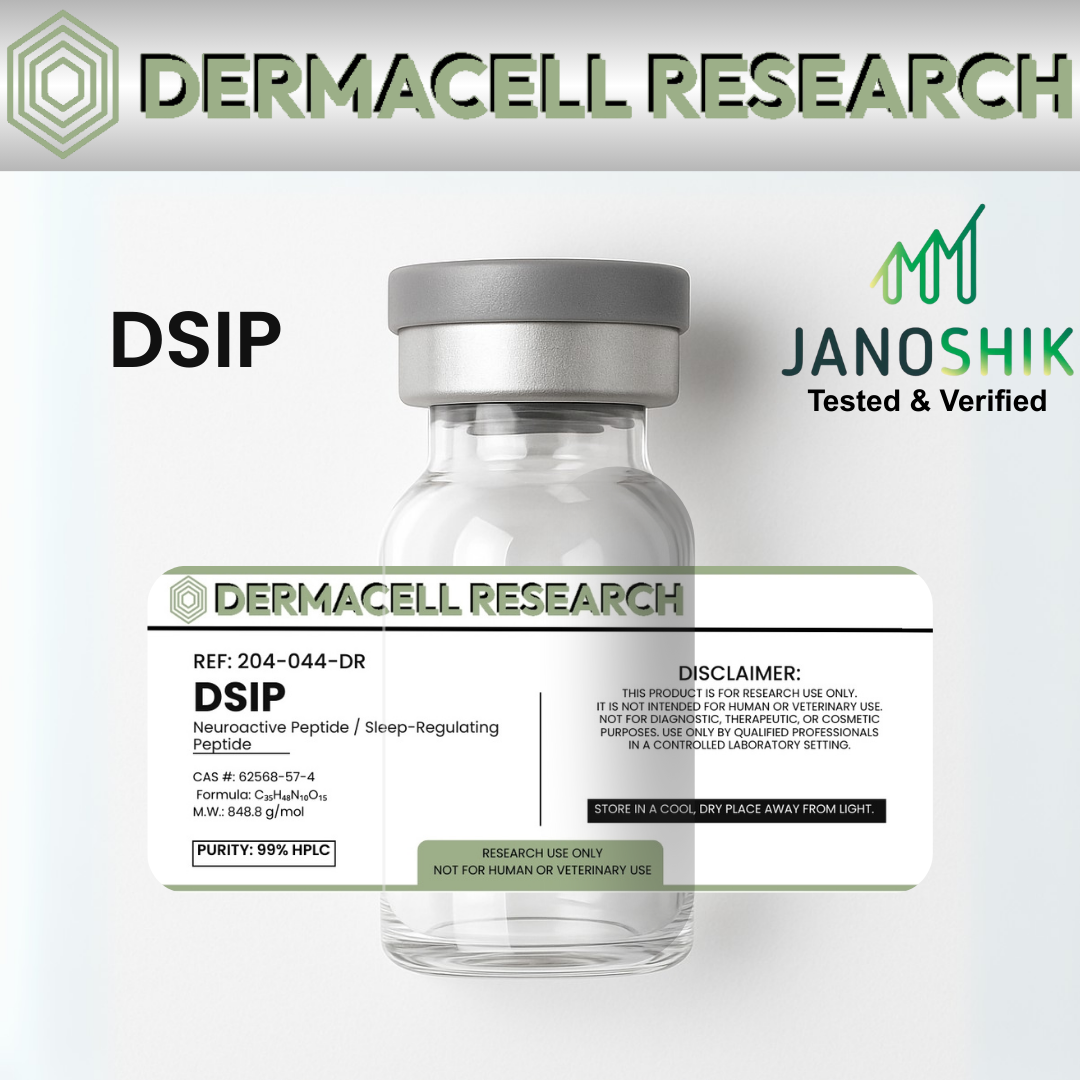
DSIP
DSIP
Regular price
$52.00
Regular price
$52.00
Sale price
Unit price
per
Lab-Tested 99% Purity
Fast, Discreet Shipping
For Research Use Only
-
Ordered
- - -
Order Ready
- - -
Delivered
Couldn't load pickup availability

DSIP
Regular price
$52.00
Regular price
$52.00
Sale price
Unit price
per
Delta Sleep-Inducing Peptide (DSIP) is a naturally occurring neuropeptide first identified in the hypothalamus and linked to the regulation of sleep-wake cycles. Research suggests it may influence slow-wave sleep, modulate stress responses, and exhibit neuroprotective and antioxidant properties.
1. Schoenenberger GA, Monnier M, Tobler I, et al. Delta sleep-inducing peptide (DSIP): discovery and characterization. Proc Natl Acad Sci U S A. 1977;74(8):3512–3516. doi:10.1073/pnas.74.8.3512
2. Graf MV, Kastin AJ, Sandman CA, et al. DSIP and sleep regulation in mammals. Peptides. 1981;2(1):9–15. doi:10.1016/0196-9781(81)90018-3
3. Kastin AJ, Ehrensing RH, Schalch DS, Anderson MS. Effects of DSIP on sleep in humans. Sleep. 1979;1(1):93–104. doi:10.1093/sleep/1.1.93
4. Ehrensing RH, Kastin AJ. Sleep-inducing properties of DSIP in humans. Pharmacol Biochem Behav. 1980;12(3):399–405. doi:10.1016/0091-3057(80)90073-0
5. Sudakov KV, et al. DSIP and stress responses in animal models. Neurosci Behav Physiol. 1999;29(4):415–420. doi:10.1007/BF02461909
6. Przewlocki R, Lason W, et al. Opioid involvement in the effects of DSIP. Life Sci. 1983;33(13):1289–1296. doi:10.1016/0024-3205(83)90784-4
7. Mamelak M. Neurobiology of DSIP and its role in circadian rhythm regulation. Neurosci Biobehav Rev. 1989;13(1):49–62. doi:10.1016/S0149-7634(89)80047-4
8. Poluektov MG, et al. Effects of DSIP on epilepsy models in rodents. Bull Exp Biol Med. 2001;132(10):950–954. doi:10.1023/A:1013120204099
9. Kastin AJ, et al. DSIP and pituitary hormone secretion. Endocrinology. 1980;106(2):421–425. doi:10.1210/endo-106-2-421
10. Monnier M, et al. Biological actions of delta sleep-inducing peptide: historical overview. Ann N Y Acad Sci. 1990;579:28–45. doi:10.1111/j.1749-6632.1990.tb21786.x
2. Graf MV, Kastin AJ, Sandman CA, et al. DSIP and sleep regulation in mammals. Peptides. 1981;2(1):9–15. doi:10.1016/0196-9781(81)90018-3
3. Kastin AJ, Ehrensing RH, Schalch DS, Anderson MS. Effects of DSIP on sleep in humans. Sleep. 1979;1(1):93–104. doi:10.1093/sleep/1.1.93
4. Ehrensing RH, Kastin AJ. Sleep-inducing properties of DSIP in humans. Pharmacol Biochem Behav. 1980;12(3):399–405. doi:10.1016/0091-3057(80)90073-0
5. Sudakov KV, et al. DSIP and stress responses in animal models. Neurosci Behav Physiol. 1999;29(4):415–420. doi:10.1007/BF02461909
6. Przewlocki R, Lason W, et al. Opioid involvement in the effects of DSIP. Life Sci. 1983;33(13):1289–1296. doi:10.1016/0024-3205(83)90784-4
7. Mamelak M. Neurobiology of DSIP and its role in circadian rhythm regulation. Neurosci Biobehav Rev. 1989;13(1):49–62. doi:10.1016/S0149-7634(89)80047-4
8. Poluektov MG, et al. Effects of DSIP on epilepsy models in rodents. Bull Exp Biol Med. 2001;132(10):950–954. doi:10.1023/A:1013120204099
9. Kastin AJ, et al. DSIP and pituitary hormone secretion. Endocrinology. 1980;106(2):421–425. doi:10.1210/endo-106-2-421
10. Monnier M, et al. Biological actions of delta sleep-inducing peptide: historical overview. Ann N Y Acad Sci. 1990;579:28–45. doi:10.1111/j.1749-6632.1990.tb21786.x