

LARGER VIALS = LARGER SAVINGS PER mg
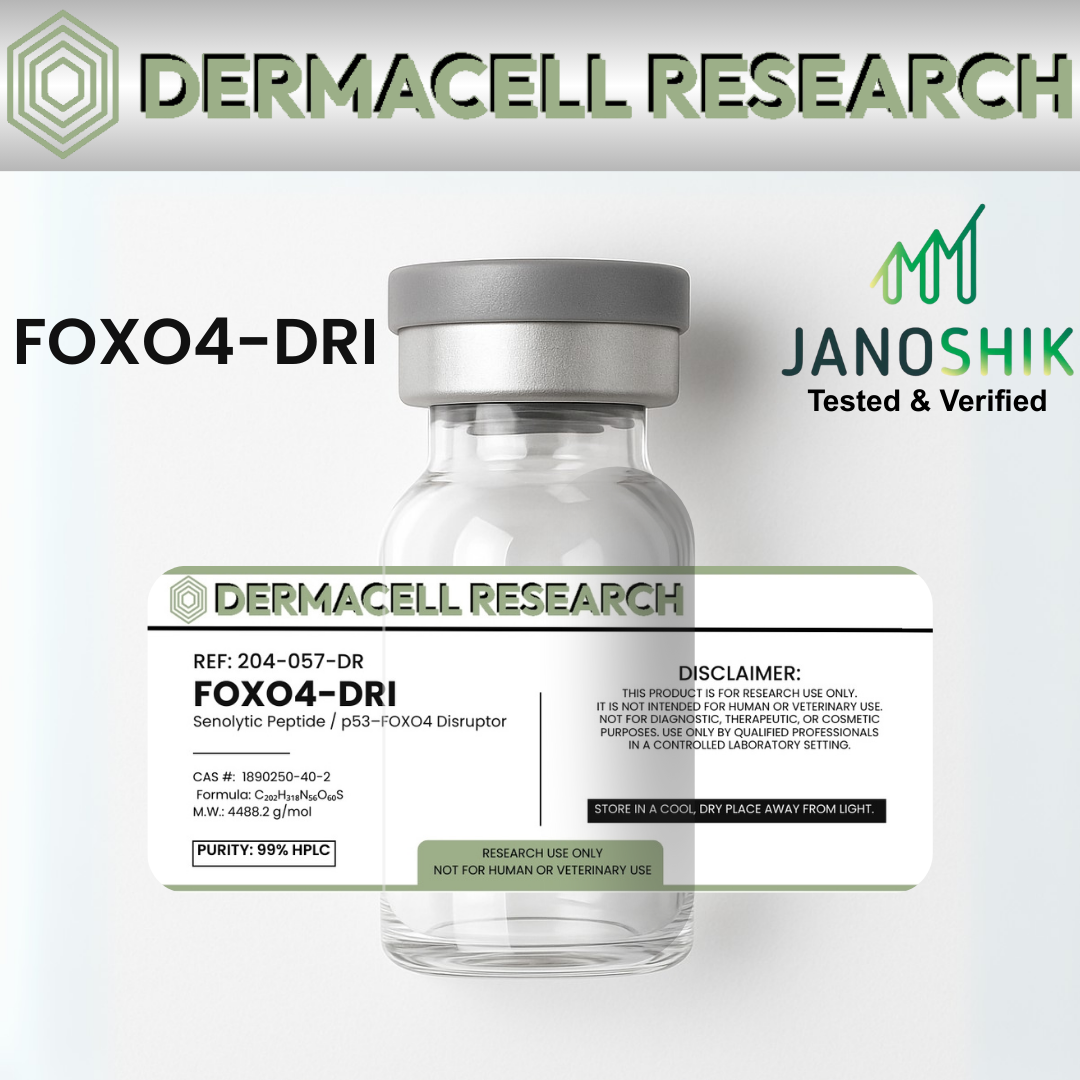
FOXO4-DRI
FOXO4-DRI
Regular price
$148.00
Regular price
$148.00
Sale price
Unit price
per
Lab-Tested 99% Purity
Fast, Discreet Shipping
For Research Use Only
-
Ordered
- - -
Order Ready
- - -
Delivered
Couldn't load pickup availability

FOXO4-DRI
Regular price
$148.00
Regular price
$148.00
Sale price
Unit price
per
FOXO4-DRI is a synthetic peptide designed to interfere with the interaction between the transcription factor FOXO4 and p53. By disrupting this binding, it promotes apoptosis of senescent cells, a process studied for its potential role in healthy aging and age-related disease management.
1. Baar MP, et al. Targeted apoptosis of senescent cells restores tissue homeostasis. Cell. 2017;169(1):132–147.e16. doi:10.1016/j.cell.2017.02.031
2. Childs BG, Durik M, Baker DJ, van Deursen JM. Cellular senescence in aging and age-related disease. Nat Med. 2015;21(12):1424–1435. doi:10.1038/nm.4000
3. Baker DJ, et al. Clearance of p16Ink4a-positive senescent cells delays aging-associated disorders. Nature. 2011;479(7372):232–236. doi:10.1038/nature10600
4. Zhu Y, et al. The Achilles’ heel of senescent cells: senolytic targets and approaches. Nat Med. 2015;21(6):666–677. doi:10.1038/nm.3885
5. Kirkland JL, Tchkonia T. Cellular senescence: a translational perspective. EBioMedicine. 2017;21:21–28. doi:10.1016/j.ebiom.2017.04.013
6. Xu M, et al. Senolytics improve physical function and increase lifespan in old age. Nat Med. 2018;24(8):1246–1256. doi:10.1038/s41591-018-0092-9
7. Yosef R, et al. Directed elimination of senescent cells by inhibition of anti-apoptotic pathways. Nat Commun. 2016;7:11190. doi:10.1038/ncomms11190
8. Herranz N, Gil J. Mechanisms and functions of cellular senescence. J Clin Invest. 2018;128(4):1238–1246. doi:10.1172/JCI95148
9. Di Micco R, Krizhanovsky V, Baker D, d’Adda di Fagagna F. Cellular senescence in ageing: from mechanisms to therapeutic opportunities. Nat Rev Mol Cell Biol. 2021;22(2):75–95. doi:10.1038/s41580-020-00314-w
10. Schafer MJ, et al. Cellular senescence and the senescence-associated secretory phenotype: therapeutic opportunities. J Clin Invest. 2020;130(12):5693–5706. doi:10.1172/JCI137472
2. Childs BG, Durik M, Baker DJ, van Deursen JM. Cellular senescence in aging and age-related disease. Nat Med. 2015;21(12):1424–1435. doi:10.1038/nm.4000
3. Baker DJ, et al. Clearance of p16Ink4a-positive senescent cells delays aging-associated disorders. Nature. 2011;479(7372):232–236. doi:10.1038/nature10600
4. Zhu Y, et al. The Achilles’ heel of senescent cells: senolytic targets and approaches. Nat Med. 2015;21(6):666–677. doi:10.1038/nm.3885
5. Kirkland JL, Tchkonia T. Cellular senescence: a translational perspective. EBioMedicine. 2017;21:21–28. doi:10.1016/j.ebiom.2017.04.013
6. Xu M, et al. Senolytics improve physical function and increase lifespan in old age. Nat Med. 2018;24(8):1246–1256. doi:10.1038/s41591-018-0092-9
7. Yosef R, et al. Directed elimination of senescent cells by inhibition of anti-apoptotic pathways. Nat Commun. 2016;7:11190. doi:10.1038/ncomms11190
8. Herranz N, Gil J. Mechanisms and functions of cellular senescence. J Clin Invest. 2018;128(4):1238–1246. doi:10.1172/JCI95148
9. Di Micco R, Krizhanovsky V, Baker D, d’Adda di Fagagna F. Cellular senescence in ageing: from mechanisms to therapeutic opportunities. Nat Rev Mol Cell Biol. 2021;22(2):75–95. doi:10.1038/s41580-020-00314-w
10. Schafer MJ, et al. Cellular senescence and the senescence-associated secretory phenotype: therapeutic opportunities. J Clin Invest. 2020;130(12):5693–5706. doi:10.1172/JCI137472