Skip to product information

LARGER VIALS = LARGER SAVINGS PER mg

IGF-1 LR3

IGF-1 LR3

Regular price $46.00
Regular price $46.00 Sale price
SAVE Liquid error (snippets/price line 116): Computation results in '-Infinity'% Sold out
 

science Lab-Tested 99% Purity

local_shipping Fast, Discreet Shipping

school For Research Use Only

 
add_shopping_cart

-

Ordered

local_shipping

- - -

Order Ready

redeem

- - -

Delivered

IGF-1 LR3

IGF-1 LR3

Regular price $46.00
Regular price $46.00 Sale price
SAVE Liquid error (snippets/price line 116): Computation results in '-Infinity'% Sold out

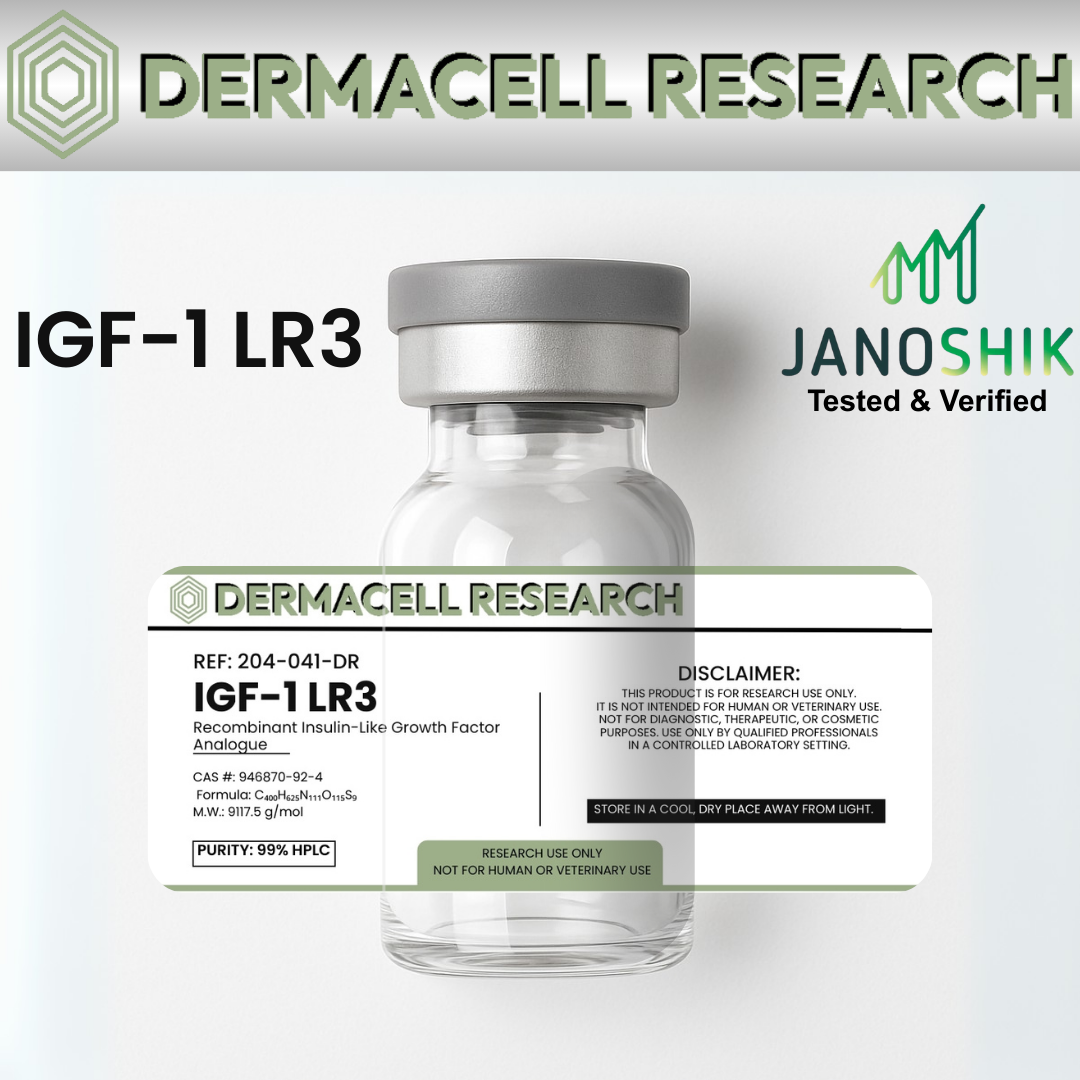
IGF-1 LR3 (Insulin-like Growth Factor-1 Long R3) is a recombinant analogue of IGF-1 with a 13-amino acid extension at the N-terminus and a substitution at position 3. These modifications reduce binding to IGF-binding proteins, prolonging its half-life and enhancing its anabolic activity in muscle and other tissues.
View full details
  • DESCRIPTION
  • STORAGE
  • REFERENCES

IGF-1 LR3 (Long Arg3 Insulin-Like Growth Factor-1) is a recombinant peptide analogue of human IGF-1, engineered for increased potency and extended half-life. It is 83 amino acids long, compared to native IGF-1 (70 amino acids), with a substitution of Arginine at position 3 and an additional 13 amino acid extension at the N-terminus. These modifications dramatically reduce binding to IGF-binding proteins (IGFBPs), thereby increasing free IGF-1 activity in circulation. IGF-1 LR3 has been studied extensively for its roles in cell proliferation, muscle hypertrophy, glucose metabolism, and regenerative biology.

Structure

  • Type: Recombinant IGF-1 analogue
  • Length: 83 amino acids
  • Modifications: Arginine substitution at position 3 + N-terminal 13 aa extension
  • Molecular Weight: ~9.2 kDa
  • Mechanism: Potent agonist of the IGF-1 receptor (IGF-1R), with reduced IGFBP binding → higher bioactivity

Research

Muscle Growth & Anabolism

  • IGF-1 LR3 stimulates satellite cell activation, myoblast proliferation, and protein synthesis.
  • Exhibits stronger anabolic effects than native IGF-1 due to greater receptor availability.

Glucose Metabolism

  • Enhances glucose uptake in muscle tissue.
  • Mimics insulin-like effects by activating downstream PI3K/Akt pathways.

Cell Proliferation & Tissue Repair

  • Promotes fibroblast and keratinocyte proliferation.
  • Studied in models of bone healing, cartilage regeneration, and wound closure.

Neuroprotection & Anti-Aging

  • IGF-1 signaling supports neuronal survival and synaptic plasticity.
  • IGF-1 LR3’s higher potency raises interest in neurodegeneration and aging research.

Safety Profile

  • Exhibits mitogenic effects, raising concerns about potential pro-cancerous activity in uncontrolled use.
  • For research use only; not approved for therapeutic application outside clinical protocols.

Summary

IGF-1 LR3 is a high-potency, long-acting analogue of IGF-1 with reduced IGFBP affinity, leading to stronger biological activity. Research highlights include:

  • Muscle hypertrophy and regeneration
  • Improved glucose metabolism
  • Wound healing and tissue repair
  • Potential in neuroprotection and anti-aging studies

This product is provided as a lyophilized powder. Store vials at 2–8 °C, protected from light and moisture. For long-term preservation, keep unopened vials at −20 °C. After reconstitution, prepare under sterile conditions, refrigerate at 2–8 °C, and use promptly. Avoid repeated freeze–thaw cycles.

1. Francis GL, et al. Insulin-like growth factor analogs with reduced binding to IGF-binding proteins. *Biochem Biophys Res Commun*. 1992;187(1):286–293. doi:10.1016/0006-291X(92)91528-S

2. Bayne ML, et al. The roles of IGFBPs in modulating IGF-1 action. *J Biol Chem*. 1989;264(20):11004–11008. PMID: 2544550

3. Adams GR, McCue SA. Local expression of IGF-1 reduces muscle atrophy in hindlimb suspension. *Am J Physiol*. 1998;275(3 Pt 1):E406–E412. doi:10.1152/ajpendo.1998.275.3.E406

4. Musarò A, et al. Localized IGF-1 transgene expression sustains hypertrophy and regeneration. *Nat Genet*. 2001;27(2):195–200. doi:10.1038/84839

5. Jones JI, Clemmons DR. Insulin-like growth factors and their binding proteins: biological actions. *Endocr Rev*. 1995;16(1):3–34. doi:10.1210/edrv-16-1-3

6. Velloso CP. Regulation of muscle mass by growth hormone and IGF-1. *Br J Pharmacol*. 2008;154(3):557–568. doi:10.1038/bjp.2008.153

7. Yakar S, et al. The role of circulating vs local IGF-1 in growth and metabolism. *Endocr Rev*. 2002;23(3):317–338. doi:10.1210/edrv.23.3.0464

8. Ewton DZ, Florini JR. IGF-1 analogues stimulate myoblast proliferation and differentiation. *Endocrinology*. 1987;120(6):2254–2262. doi:10.1210/endo-120-6-2254

9. Baserga R. The IGF-1 receptor as an essential signal transducer for cell growth. *Int J Cancer*. 1999;80(6):802–806. doi:10.1002/(SICI)1097-0215(19990315)80:6<802::AID-IJC2>3.0.CO;2-L

10. LeRoith D, et al. Insulin-like growth factors in physiology and disease. *N Engl J Med*. 1995;336(9):633–640. doi:10.1056/NEJM199702273360907