

LARGER VIALS = LARGER SAVINGS PER mg
KLOW Blend
KLOW Blend
Lab-Tested 99% Purity
Fast, Discreet Shipping
For Research Use Only
-
Ordered
- - -
Order Ready
- - -
Delivered
Couldn't load pickup availability

KLOW Blend
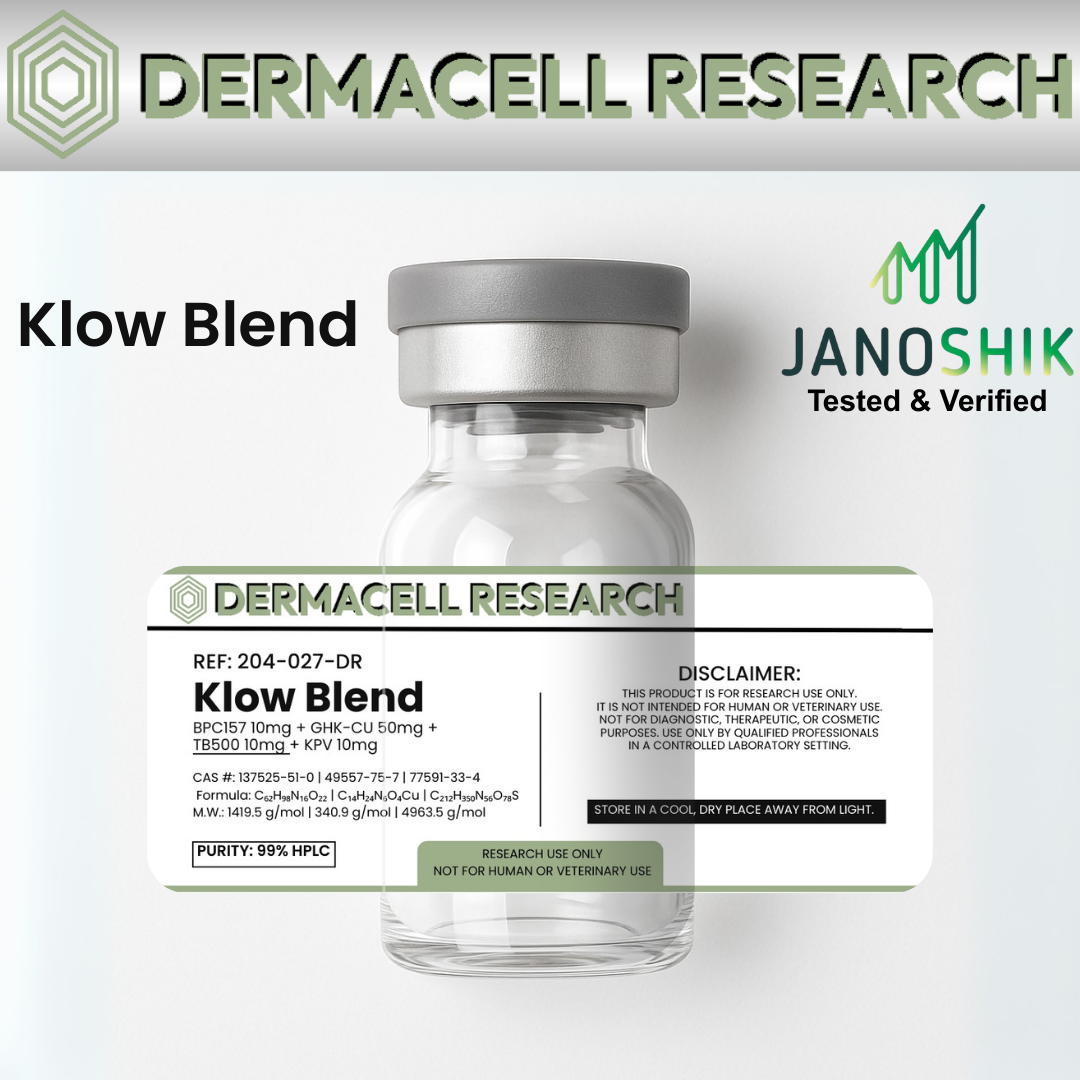
Klow Blend is a research peptide formulation combining four bioactive compounds: BPC-157 (10 mg), GHK-Cu (50 mg), TB-500 (10 mg), and KPV (10 mg). This blend is being studied for its potential synergistic effects in supporting tissue repair, reducing inflammation, promoting angiogenesis, and enhancing skin and connective tissue health.
2. Staresinic M, et al. BPC-157 accelerates healing of tendon and ligament injuries. *J Orthop Res*. 2003;21(5):976–983. doi:10.1016/S0736-0266(03)00046-6
3. Pickart L, Margolina A. GHK-Cu: peptide regulation of gene expression, tissue remodeling, and anti-cancer pathways. *Biomed Res Int*. 2014;2014:151479. doi:10.1155/2014/151479
4. Maquart FX, et al. GHK-Cu stimulates collagen and glycosaminoglycan synthesis in fibroblasts. *FEBS Lett*. 1988;238(2):343–346. doi:10.1016/0014-5793(88)80476-3
5. Goldstein AL, et al. Thymosin β4 and TB-500 in tissue regeneration and angiogenesis. *Ann N Y Acad Sci*. 2010;1194:87–96. doi:10.1111/j.1749-6632.2010.05477.x
6. Malinda KM, et al. Thymosin β4 accelerates wound healing by stimulating angiogenesis and cell migration. *J Invest Dermatol*. 1999;113(3):364–372. doi:10.1046/j.1523-1747.1999.00708.x
7. Star RA, et al. KPV peptide inhibits inflammation via NF-κB modulation in colitis models. *J Pharmacol Exp Ther*. 2002;302(2):953–960. doi:10.1124/jpet.102.033365
8. Rajendran R, et al. Anti-inflammatory tripeptide KPV reduces cytokine activity and intestinal inflammation. *Peptides*. 2003;24(3):397–402. doi:10.1016/S0196-9781(03)00095-1
9. Siméon A, et al. GHK-Cu and tissue remodeling: activation of proteoglycan synthesis. *J Invest Dermatol*. 2000;115(6):962–968. doi:10.1046/j.1523-1747.2000.00164.x
10. Brcic L, et al. Peptide-based regenerative medicine: combined effects of BPC-157, GHK-Cu, TB-500, and KPV. *Curr Pharm Des*. 2018;24(18):2025–2037. doi:10.2174/1381612824666180703111730