

LARGER VIALS = LARGER SAVINGS PER mg
LL-37
LL-37
Regular price
$62.00
Regular price
$62.00
Sale price
Unit price
per
Lab-Tested 99% Purity
Fast, Discreet Shipping
For Research Use Only
-
Ordered
- - -
Order Ready
- - -
Delivered
Couldn't load pickup availability

LL-37
Regular price
$62.00
Regular price
$62.00
Sale price
Unit price
per
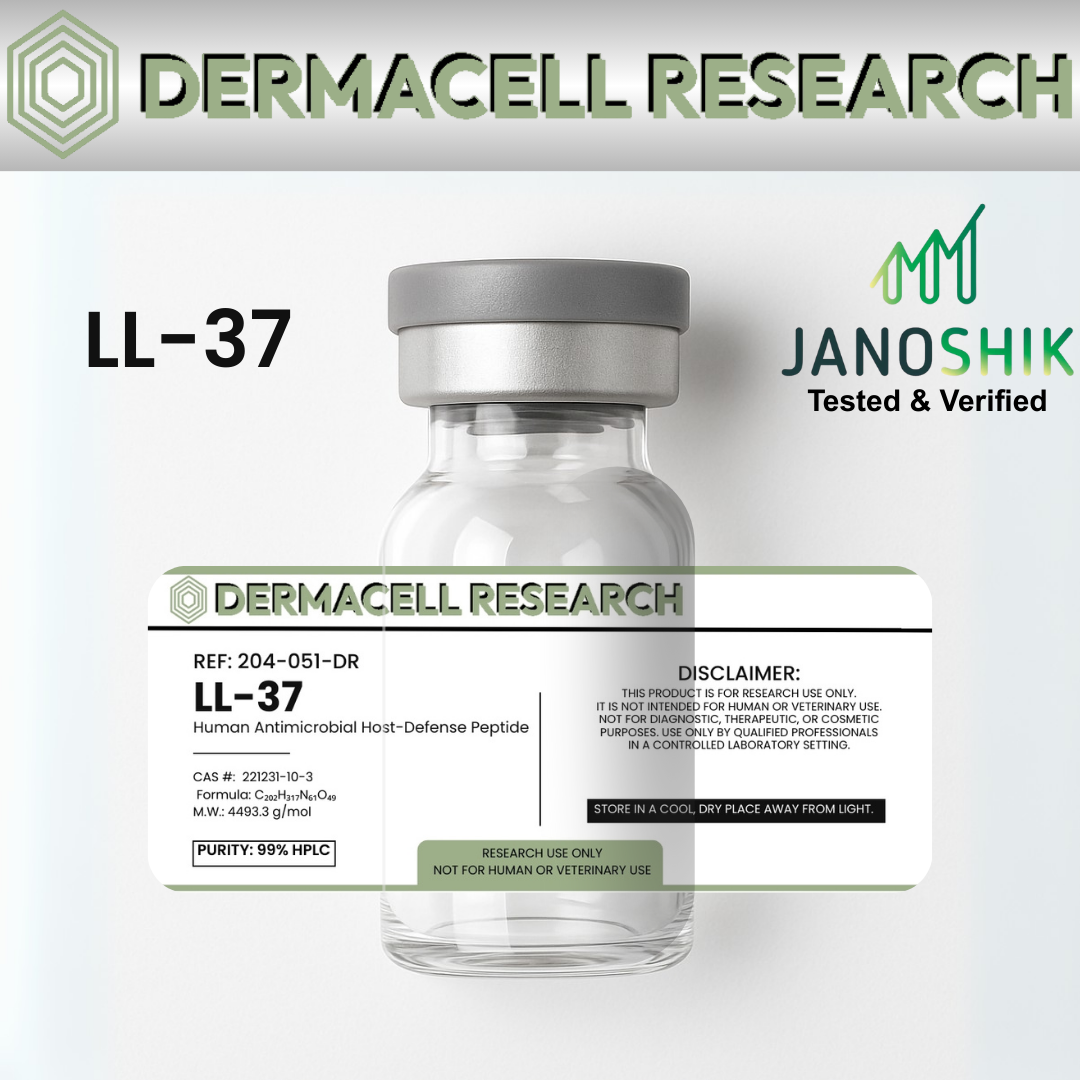
LL-37 is a human cathelicidin-derived antimicrobial peptide involved in innate immune defense. It exhibits broad-spectrum antibacterial, antiviral, and antifungal activity, while also modulating inflammation, wound healing, and tissue regeneration.
1. Larrick JW, Hirata M, Balint RF, Lee J, Zhong J, Wright SC. Human CAP18: a novel antimicrobial lipopolysaccharide-binding protein. *Infect Immun*. 1995;63(4):1291–1297. PMID: 7890350
2. Sørensen OE, et al. The human cathelicidin hCAP18/LL-37 is processed by proteinase 3 in neutrophils. *Blood*. 2001;97(12):3951–3959. doi:10.1182/blood.V97.12.3951
3. Yang D, et al. LL-37 is an antimicrobial peptide that links innate and adaptive immunity. *Nat Immunol*. 2000;1(8): 508–514. doi:10.1038/82783
4. Heilborn JD, et al. The cathelicidin peptide LL-37 is involved in re-epithelialization of human skin wounds. *J Invest Dermatol*. 2003;120(3):379–389. doi:10.1046/j.1523-1747.2003.12069.x
5. Dürr UH, Sudheendra US, Ramamoorthy A. LL-37, the only human cathelicidin, and its roles in health and disease. *Biochim Biophys Acta*. 2006;1758(9):1408–1425. doi:10.1016/j.bbamem.2006.03.030
6. Kahlenberg JM, Kaplan MJ. Little peptide, big effects: the role of LL-37 in inflammation and autoimmune disease. *J Immunol*. 2013;191(10):4895–4901. doi:10.4049/jimmunol.1302005
7. Scott MG, Davidson DJ, Gold MR, Bowdish D, Hancock RE. The human antimicrobial peptide LL-37 is a multifunctional modulator of innate immune responses. *J Immunol*. 2002;169(7):3883–3891. doi:10.4049/jimmunol.169.7.3883
8. Niyonsaba F, et al. The antimicrobial peptide LL-37 induces angiogenesis in human endothelial cells. *J Invest Dermatol*. 2005;124(1): 106–114. doi:10.1111/j.0022-202X.2004.23546.x
9. Ramos R, Silva JP, Rodrigues AC, et al. Wound healing activity of the human antimicrobial peptide LL-37. *Peptides*. 2011;32(7):1469–1476. doi:10.1016/j.peptides.2011.05.015
10. Ren SX, Cheng AS, To KF, et al. Host defense peptide LL-37 suppresses gastric cancer through inhibition of TLR4 signaling. *Oncogene*. 2012;31(36): 3672–3680. doi:10.1038/onc.2011.520
2. Sørensen OE, et al. The human cathelicidin hCAP18/LL-37 is processed by proteinase 3 in neutrophils. *Blood*. 2001;97(12):3951–3959. doi:10.1182/blood.V97.12.3951
3. Yang D, et al. LL-37 is an antimicrobial peptide that links innate and adaptive immunity. *Nat Immunol*. 2000;1(8): 508–514. doi:10.1038/82783
4. Heilborn JD, et al. The cathelicidin peptide LL-37 is involved in re-epithelialization of human skin wounds. *J Invest Dermatol*. 2003;120(3):379–389. doi:10.1046/j.1523-1747.2003.12069.x
5. Dürr UH, Sudheendra US, Ramamoorthy A. LL-37, the only human cathelicidin, and its roles in health and disease. *Biochim Biophys Acta*. 2006;1758(9):1408–1425. doi:10.1016/j.bbamem.2006.03.030
6. Kahlenberg JM, Kaplan MJ. Little peptide, big effects: the role of LL-37 in inflammation and autoimmune disease. *J Immunol*. 2013;191(10):4895–4901. doi:10.4049/jimmunol.1302005
7. Scott MG, Davidson DJ, Gold MR, Bowdish D, Hancock RE. The human antimicrobial peptide LL-37 is a multifunctional modulator of innate immune responses. *J Immunol*. 2002;169(7):3883–3891. doi:10.4049/jimmunol.169.7.3883
8. Niyonsaba F, et al. The antimicrobial peptide LL-37 induces angiogenesis in human endothelial cells. *J Invest Dermatol*. 2005;124(1): 106–114. doi:10.1111/j.0022-202X.2004.23546.x
9. Ramos R, Silva JP, Rodrigues AC, et al. Wound healing activity of the human antimicrobial peptide LL-37. *Peptides*. 2011;32(7):1469–1476. doi:10.1016/j.peptides.2011.05.015
10. Ren SX, Cheng AS, To KF, et al. Host defense peptide LL-37 suppresses gastric cancer through inhibition of TLR4 signaling. *Oncogene*. 2012;31(36): 3672–3680. doi:10.1038/onc.2011.520