Skip to product information

LARGER VIALS = LARGER SAVINGS PER mg

Melanotan 1

Melanotan 1

Regular price $52.00
Regular price $52.00 Sale price
SAVE Liquid error (snippets/price line 116): Computation results in '-Infinity'% Sold out
 

science Lab-Tested 99% Purity

local_shipping Fast, Discreet Shipping

school For Research Use Only

 
add_shopping_cart

-

Ordered

local_shipping

- - -

Order Ready

redeem

- - -

Delivered

Melanotan 1

Melanotan 1

Regular price $52.00
Regular price $52.00 Sale price
SAVE Liquid error (snippets/price line 116): Computation results in '-Infinity'% Sold out

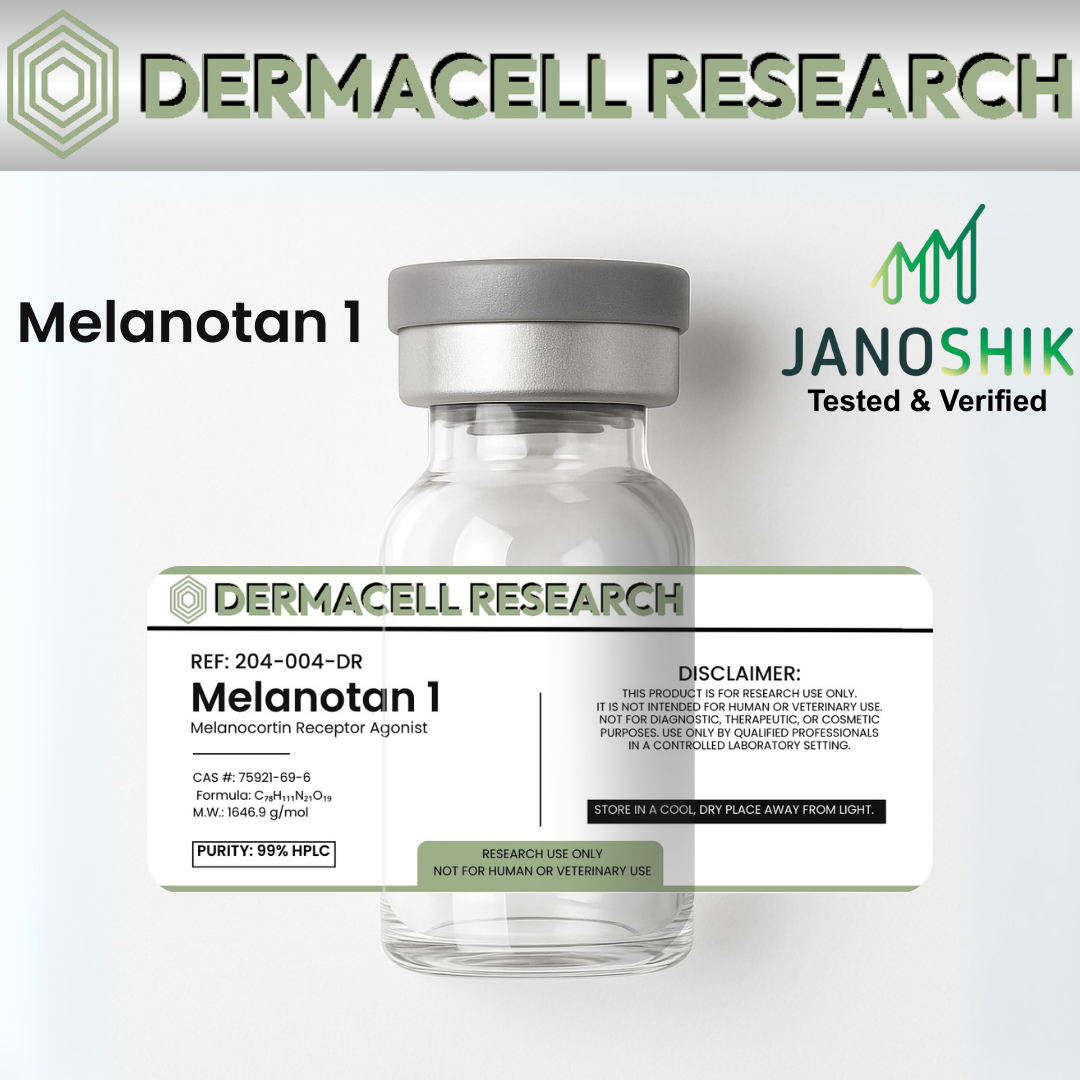
Melanotan I (MT-1, Afamelanotide) is a synthetic analog of α-melanocyte-stimulating hormone (α-MSH) that acts as an agonist at melanocortin receptors. It has been studied for its ability to increase skin pigmentation, provide photoprotection against UV damage, and reduce risk in individuals with photosensitivity disorders.
View full details
  • DESCRIPTION
  • STORAGE
  • REFERENCES

Melanotan 1 (afamelanotide, NDP-MSH) is a synthetic analogue of α-melanocyte-stimulating hormone (α-MSH). It selectively activates the melanocortin 1 receptor (MC1R), leading to increased melanin production (melanogenesis) in the skin. Unlike Melanotan 2, Melanotan 1 does not significantly stimulate other melanocortin receptors, giving it a more targeted activity profile. Afamelanotide has been studied for skin photoprotection, tanning, and treatment of rare disorders like erythropoietic protoporphyria (EPP).

Structure

  • Type: Synthetic linear peptide analogue of α-MSH
  • Sequence: Ac-Ser-Tyr-Ser-Nle-Glu-His-D-Phe-Arg-Trp-Gly-Lys-Pro-Val-NH₂
  • Molecular Weight: ~1646 Da
  • Mechanism: MC1R activation → ↑ eumelanin synthesis → enhanced pigmentation and photoprotection

Research

Photoprotection & Dermatology

  • Increases eumelanin production, darkening skin and reducing UV-induced DNA damage.
  • Clinical trials demonstrate benefit in EPP patients, improving tolerance to sunlight exposure.

Tanning & Aesthetics

  • Studied as a tanning agent due to its ability to increase pigmentation independent of sun exposure.

Anti-Cancer Potential

  • By reducing UV damage, Melanotan 1 may lower the risk of skin cancers in high-risk individuals.

Safety Profile

  • Generally well tolerated in clinical studies.
  • Reported effects include mild nausea, flushing, or tanning-related changes.
  • Unlike Melanotan 2, it does not typically cause libido changes or appetite suppression.

Summary

Melanotan 1 is a synthetic α-MSH analogue that selectively stimulates MC1R to enhance skin pigmentation. Research highlights include:

  • Increased melanin production and UV protection
  • Applications in EPP and photodermatoses
  • Studied for aesthetic tanning and skin cancer prevention
  • Favorable safety profile with targeted MC1R activity

This peptide is supplied as a lyophilized powder. Store at 2–8 °C, protected from light and moisture. For long-term preservation, keep unopened vials at −20 °C. After reconstitution, prepare solutions under sterile conditions, refrigerate at 2–8 °C, and use promptly. Avoid repeated freeze–thaw cycles.

1. Sawyer TK, et al. Design of potent melanotropin analogues: biological activities of Melanotan 1. *Peptides*. 1980;1(2):119–122. doi:10.1016/0196-9781(80)90034-4

2. Thody AJ, et al. α-MSH and related peptides influence human pigmentation. *Ann N Y Acad Sci*. 1993;680:197–204. doi:10.1111/j.1749-6632.1993.tb19682.x

3. Kleinman HK, et al. Melanocortins and skin pigmentation. *Arch Dermatol Res*. 1996;288(7):439–442. doi:10.1007/BF02507177

4. Langendonk JG, et al. Afamelanotide for erythropoietic protoporphyria. *N Engl J Med*. 2015;373(1):48–59. doi:10.1056/NEJMoa1411480

5. Minder EI, et al. Afamelanotide (Scenesse) improves life quality in EPP patients. *Orphanet J Rare Dis*. 2014;9:168. doi:10.1186/s13023-014-0168-4

6. Dorr RT, et al. Clinical pharmacology of the melanocortin peptide Melanotan 1. *Clin Pharmacol Ther*. 2000;68(1):34–40. doi:10.1067/mcp.2000.107340

7. Abdel-Malek ZA, et al. Melanocortins and human melanocytes: regulation of pigmentation. *Pigment Cell Res*. 2001;14(3):153–160. doi:10.1034/j.1600-0749.2001.140302.x

8. Lecha M, et al. Afamelanotide as an orphan drug for photoprotection in EPP. *Br J Dermatol*. 2009;161(Suppl 3):68–72. doi:10.1111/j.1365-2133.2009.09448.x

9. Fabrikant J, Touloei K, Brown SM. A review of melanocortin analogs in dermatology. *Dermatol Online J*. 2013;19(7):20392. PMID: 23889406

10. Naeyaert JM, et al. The role of melanocortins in UV protection and skin pigmentation. *Photochem Photobiol*. 1991;54(5):753–760. doi:10.1111/j.1751-1097.1991.tb02015.x