

LARGER VIALS = LARGER SAVINGS PER mg
SLU-PP-332
SLU-PP-332
Regular price
$80.00
Regular price
$80.00
Sale price
Unit price
per
Lab-Tested 99% Purity
Fast, Discreet Shipping
For Research Use Only
-
Ordered
- - -
Order Ready
- - -
Delivered
Couldn't load pickup availability

SLU-PP-332
Regular price
$80.00
Regular price
$80.00
Sale price
Unit price
per
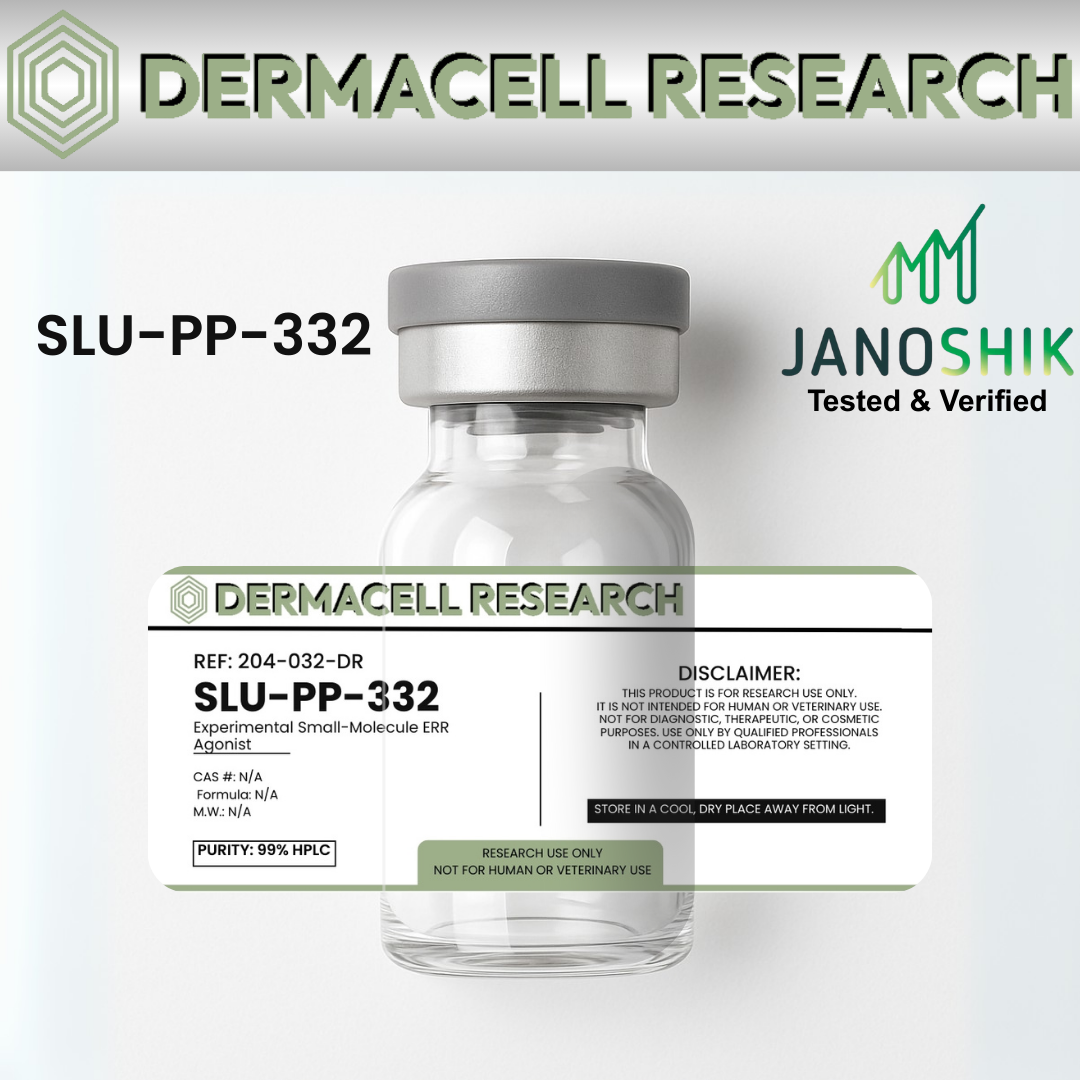
SLU-PP-332 is an experimental small-molecule agonist of the estrogen-related receptor (ERR) family. It has been investigated for its ability to enhance mitochondrial biogenesis, increase energy expenditure, and improve metabolic function, with potential applications in obesity and metabolic disease research.
1. Narkar VA, et al. AMPK and PPARδ agonists mimic exercise by altering muscle metabolism. *Cell*. 2008;134(3):405–415. doi:10.1016/j.cell.2008.06.051
2. Fan W, et al. PPARδ promotes oxidative muscle fiber specification and endurance. *Proc Natl Acad Sci U S A*. 2017;114(36):E7419–E7428. doi:10.1073/pnas.1706895114
3. Schuler M, et al. PPARδ as a nuclear receptor regulator of metabolism and exercise adaptation. *J Biol Chem*. 2006;281(31):21266–21274. doi:10.1074/jbc.M602394200
4. Wang YX, et al. Regulation of muscle fiber type and metabolism by PPARδ. *PLoS Biol*. 2004;2(10):e294. doi:10.1371/journal.pbio.0020294
5. Dressel U, et al. PPARδ agonism improves glucose metabolism in skeletal muscle. *Endocrinology*. 2003;144(3): 1143–1153. doi:10.1210/en.2002-220732
6. Oliver WR, et al. A selective PPARδ agonist promotes reverse cholesterol transport. *Proc Natl Acad Sci U S A*. 2001;98(9):5306–5311. doi:10.1073/pnas.091021198
7. Luquet S, et al. PPARδ controls muscle oxidative capacity and endurance. *FASEB J*. 2003;17(15):2299–2301. doi:10.1096/fj.03-0388fje
8. Xu HE, et al. Structural basis for ligand activation of PPARδ. *Mol Cell*. 2002;10(3):687–698. doi:10.1016/S1097-2765(02)00650-0
9. Krämer DK, et al. PPARδ activation enhances skeletal muscle fatty acid oxidation and endurance. *Am J Physiol Endocrinol Metab*. 2005;288(6):E1259–E1267. doi:10.1152/ajpendo.00475.2004
10. Tanaka T, et al. Therapeutic implications of PPARδ agonists in obesity and metabolic syndrome. *Pharmacol Ther*. 2003;100(2):159–173. doi:10.1016/j.pharmthera.2003.08.002
2. Fan W, et al. PPARδ promotes oxidative muscle fiber specification and endurance. *Proc Natl Acad Sci U S A*. 2017;114(36):E7419–E7428. doi:10.1073/pnas.1706895114
3. Schuler M, et al. PPARδ as a nuclear receptor regulator of metabolism and exercise adaptation. *J Biol Chem*. 2006;281(31):21266–21274. doi:10.1074/jbc.M602394200
4. Wang YX, et al. Regulation of muscle fiber type and metabolism by PPARδ. *PLoS Biol*. 2004;2(10):e294. doi:10.1371/journal.pbio.0020294
5. Dressel U, et al. PPARδ agonism improves glucose metabolism in skeletal muscle. *Endocrinology*. 2003;144(3): 1143–1153. doi:10.1210/en.2002-220732
6. Oliver WR, et al. A selective PPARδ agonist promotes reverse cholesterol transport. *Proc Natl Acad Sci U S A*. 2001;98(9):5306–5311. doi:10.1073/pnas.091021198
7. Luquet S, et al. PPARδ controls muscle oxidative capacity and endurance. *FASEB J*. 2003;17(15):2299–2301. doi:10.1096/fj.03-0388fje
8. Xu HE, et al. Structural basis for ligand activation of PPARδ. *Mol Cell*. 2002;10(3):687–698. doi:10.1016/S1097-2765(02)00650-0
9. Krämer DK, et al. PPARδ activation enhances skeletal muscle fatty acid oxidation and endurance. *Am J Physiol Endocrinol Metab*. 2005;288(6):E1259–E1267. doi:10.1152/ajpendo.00475.2004
10. Tanaka T, et al. Therapeutic implications of PPARδ agonists in obesity and metabolic syndrome. *Pharmacol Ther*. 2003;100(2):159–173. doi:10.1016/j.pharmthera.2003.08.002