

LARGER VIALS = LARGER SAVINGS PER mg
TB-500
TB-500
Regular price
$58.00
Regular price
$58.00
Sale price
Unit price
per
Lab-Tested 99% Purity
Fast, Discreet Shipping
For Research Use Only
-
Ordered
- - -
Order Ready
- - -
Delivered
Couldn't load pickup availability

TB-500
Regular price
$58.00
Regular price
$58.00
Sale price
Unit price
per
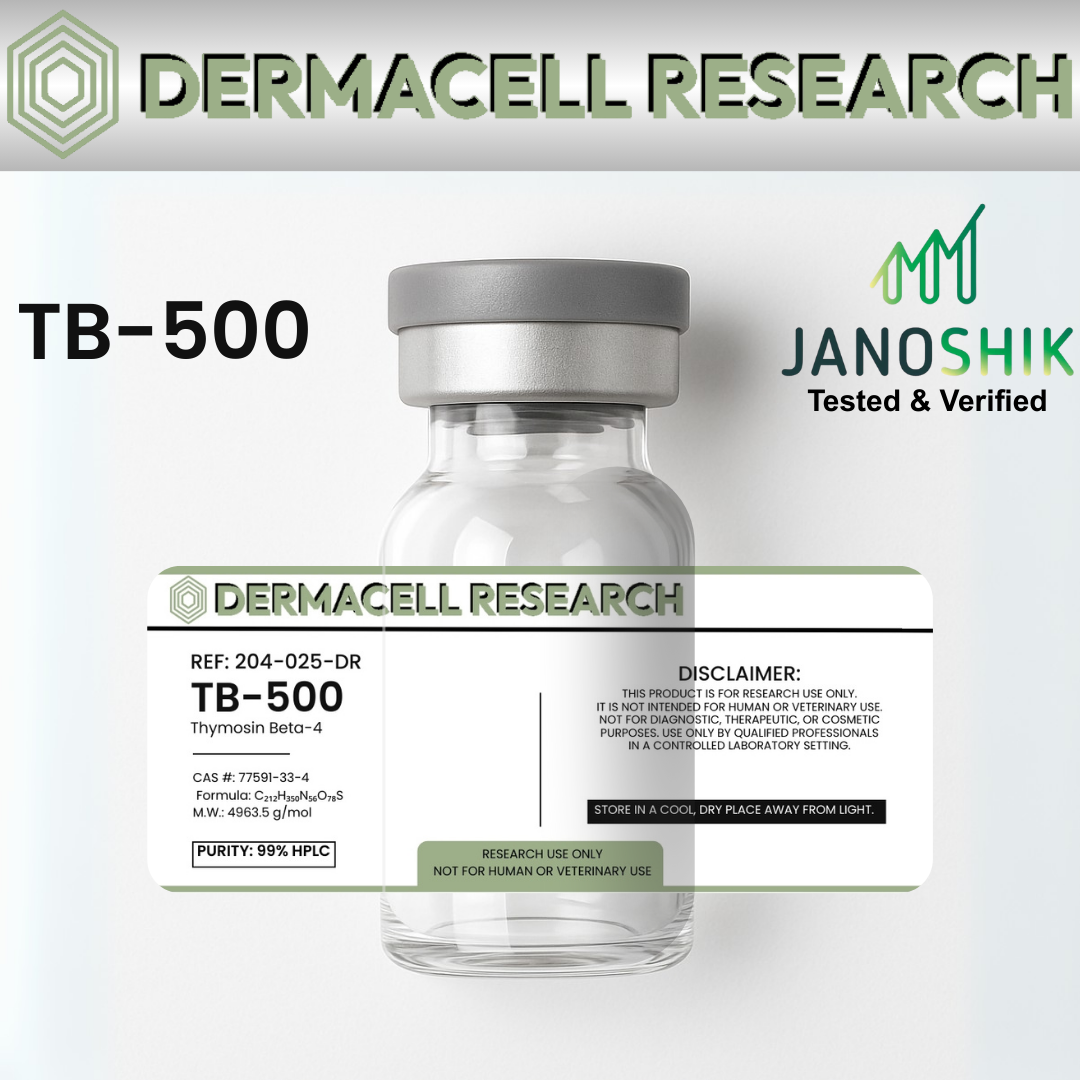
TB-500 (Thymosin Beta-4 Fragment) is a synthetic peptide consisting of the active region of thymosin beta-4. It has been studied for its ability to promote angiogenesis, support wound healing, enhance cell migration, and reduce inflammation in various tissues.
1. Goldstein AL, et al. Thymosin beta 4: a multifunctional tissue repair and regeneration peptide. *Ann N Y Acad Sci*. 2012;1269:92–101. doi:10.1111/j.1749-6632.2012.06737.x
2. Sosne G, et al. Thymosin beta 4 promotes corneal wound healing. *Invest Ophthalmol Vis Sci*. 2002;43(12):3820–3827. PMID: 12454047
3. Malinda KM, et al. Thymosin beta 4 stimulates directional migration of endothelial cells. *J Cell Sci*. 1997;110(Pt 19):2285–2295. doi:10.1242/jcs.110.19.2285
4. Crockford D. Development of thymosin beta 4 for treatment of heart failure and stroke. *Ann N Y Acad Sci*. 2007;1112:385–395. doi:10.1196/annals.1415.011
5. Bock-Marquette I, et al. Thymosin beta 4 activates integrin-linked kinase and promotes cardiac cell migration and survival. *Nature*. 2004;432(7016):466–472. doi:10.1038/nature03000
6. Smart N, et al. Thymosin beta 4 induces adult epicardial progenitor mobilization and neovascularization. *Nature*. 2007;445(7124):177–182. doi:10.1038/nature05383
7. Morris DC, et al. Neuroprotective potential of thymosin beta 4 in experimental stroke. *Neurobiol Dis*. 2010;40(1):36–44. doi:10.1016/j.nbd.2010.05.003
8. Philp D, et al. Thymosin beta 4 reduces inflammation and fibrosis in wound healing. *J Invest Dermatol*. 2004;122(5):1137–1146. doi:10.1111/j.0022-202X.2004.22411.x
9. Wei L, et al. Thymosin beta 4 improves neurological recovery and angiogenesis after stroke in rats. *Ann Neurol*. 2007;61(3):281–292. doi:10.1002/ana.21076
10. Grant DS, et al. Thymosin beta 4 promotes angiogenesis and endothelial cell differentiation. *FASEB J*. 1995;9(10): 1402–1409. doi:10.1096/fasebj.9.10.7615153
2. Sosne G, et al. Thymosin beta 4 promotes corneal wound healing. *Invest Ophthalmol Vis Sci*. 2002;43(12):3820–3827. PMID: 12454047
3. Malinda KM, et al. Thymosin beta 4 stimulates directional migration of endothelial cells. *J Cell Sci*. 1997;110(Pt 19):2285–2295. doi:10.1242/jcs.110.19.2285
4. Crockford D. Development of thymosin beta 4 for treatment of heart failure and stroke. *Ann N Y Acad Sci*. 2007;1112:385–395. doi:10.1196/annals.1415.011
5. Bock-Marquette I, et al. Thymosin beta 4 activates integrin-linked kinase and promotes cardiac cell migration and survival. *Nature*. 2004;432(7016):466–472. doi:10.1038/nature03000
6. Smart N, et al. Thymosin beta 4 induces adult epicardial progenitor mobilization and neovascularization. *Nature*. 2007;445(7124):177–182. doi:10.1038/nature05383
7. Morris DC, et al. Neuroprotective potential of thymosin beta 4 in experimental stroke. *Neurobiol Dis*. 2010;40(1):36–44. doi:10.1016/j.nbd.2010.05.003
8. Philp D, et al. Thymosin beta 4 reduces inflammation and fibrosis in wound healing. *J Invest Dermatol*. 2004;122(5):1137–1146. doi:10.1111/j.0022-202X.2004.22411.x
9. Wei L, et al. Thymosin beta 4 improves neurological recovery and angiogenesis after stroke in rats. *Ann Neurol*. 2007;61(3):281–292. doi:10.1002/ana.21076
10. Grant DS, et al. Thymosin beta 4 promotes angiogenesis and endothelial cell differentiation. *FASEB J*. 1995;9(10): 1402–1409. doi:10.1096/fasebj.9.10.7615153